Continuous Galvanizing Lines · Monterrey
CGL pot roll services
in Mexico.
For sink, stabilizer and corrector rolls: HVOF coating and ceramic sealing, precision machining and grinding, and cobalt-based superalloy hardware.
Bring us your drawing or application requirements. Our technical team can help define and execute the work across roll geometry, grooving, coating and hardware.

- Coating & ceramic sealing
- Specially formulated tungsten carbide HVOF coatings for submerged molten-zinc service, with non-wetting ceramic sealing to help limit zinc and dross adhesion.
- Roll geometry & grooving
- Machining and precision grinding of cylindrical or crowned profiles; macro/micro grooves in circumferential or helical arrangements.
- Superalloy hardware
- Cobalt-alloy sleeves and end-caps, plus sleeve systems with hardfaced wear bands for pot-roll assemblies.
Submerged pot rolls.
Coating, machining, grinding and hardware for sink, stabilizer and corrector rolls used in continuous zinc galvanizing.
General process rolls
While we specialize in pot rolls, we provide coating, grinding and finishing services for most general process rolls, including bridle, pinch, accumulator, annealing furnace, deflector, burr-masher and pick-up rolls, among others.
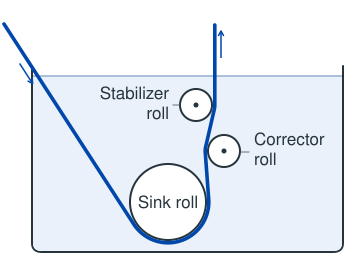
An integrated route
for pot rolls.
For pot rolls, body geometry, crown profiles and grooves are machined before surface preparation and HVOF coating. The coating is normally retained as sprayed; ceramic sealing and dimensional inspection follow.
- 01Application, engineering & NDT
Application review, process planning and third-party NDT coordination.
- 02Machining & grinding
Turning and grinding of roll bodies, crown profiles and grooves.
- 03Surface preparation
Grit blasting to prepare roll surfaces for HVOF coating.
- 04HVOF coating
Application of tungsten carbide coating formulated for submerged molten-zinc service.
- 05Ceramic sealing
Sealing the coating with a ceramic system non-wetting to molten zinc.
- 06Dimensional inspection
In-house checks of diameters, lengths, surface roughness and runout.
Roll profiles
and grooving.
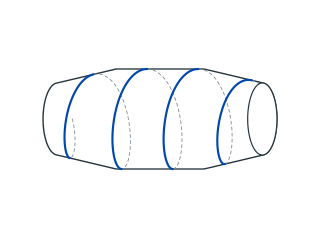
TECMA machines and grinds cylindrical and crowned roll profiles, with macro and micro-grooving in circumferential or helical arrangements. Grooving can also follow circular-arc and trapezoidal crowns.
- Macro & micro grooves
- Conventional macro grooves and finer micro-grooving for pot roll surfaces.
- Circumferential or helical
- Circumferential and helical arrangements, including helices that start at both ends and meet at the roll center.
- Crown-following grooving
- Grooves that follow the changing diameter of circular-arc and trapezoidal crowns.

Macro & micro grooves
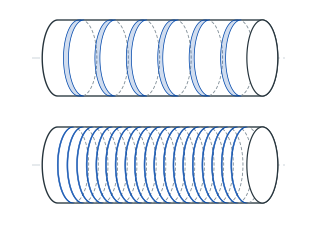
Circumferential or helical
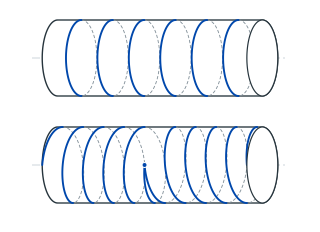
Crown-following grooving
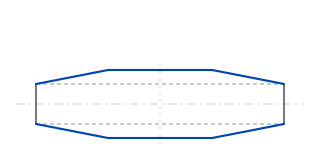
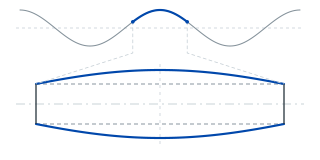
Crown profile generation
Trapezoidal crown
Cosine crown
Circular-arc crown
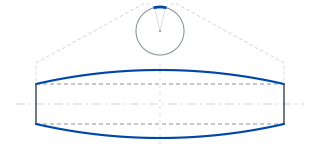
Schematic; profiles and grooves exaggerated for clarity. Not to scale.
Less buildup.
Preserve roll function.
TECMA applies specially formulated tungsten carbide HVOF coatings designed to resist wear and chemical attack by molten zinc. Non-wetting ceramic sealing helps limit zinc and dross adhesion at the roll surface.
For reconditioning work, TECMA brings surface protection, profile and groove restoration, and dimensional inspection into one coordinated service. Our team can help define that scope from the roll’s condition and operating requirements.

Limit zinc and dross buildup
A non-wetting seal helps reduce adhesion at the roll surface, supporting more uniform strip contact and fewer buildup-related marks and vibrations.
Maintain traction and rotation
Retaining functional surface roughness helps limit strip slip and loss of roll traction. The typical as-sprayed finish serves that function.
Protect profiles and grooves
Wear-resistant coating helps retain the geometry that supports strip guidance and drainage at the contact surface.
Surface finishes for coated rolls
Pot rolls typically retain the as-sprayed texture for strip traction. Other rolls and coated components may require peak reduction, precise grinding or progressively finer finishing for their contact and sealing functions.

- As-sprayed
- Retains the original coating texture for maximum strip traction. Typical for pot rolls, followed by ceramic sealing.
- Pre-conditioned (diamond abrasive)
- Light finishing with diamond abrasive reduces surface peaks while retaining much of the coating texture and good strip traction. This controlled wear-in treatment reduces the tendency for flakes to become embedded and initiate buildup.
- Diamond-ground
- Controls diameter and profile while producing a smooth, uniform surface. Used when very precise roll form and a smooth contact finish are required.
- Superfinished
- Further refines the ground surface, reducing surface roughness and grinding marks while improving cylindricity and microgeometry. Produces a finer surface with a controlled crosshatch pattern that helps retain and distribute lubricant. Well suited to elastomeric seal contact surfaces and hydraulic piston rods.
- Polished
- Fine finishing for mirror and super-mirror surfaces, while retaining the dimensional and profile precision established by preceding processes.
Superalloy hardware.
Application-led selection.
Open-ended and blind sleeves, end-caps and hardfaced wear bands operate under heat, wear and molten-metal exposure. TECMA supplies this hardware at commercial scale and helps select the alloy and manufacturing route around the component’s operating conditions.
- Open-ended and blind sleeves
- End-caps / buttons
- Sleeves with hardfaced wear bands
Supporting 316L components, including retaining rings, are also available.

Cobalt alloys: two different property balances
| Alloy | Properties | Selection for the plant |
|---|---|---|
| Alloy 6 Cobalt–chromium–tungsten · standard cast option | Good hot hardness, with balanced wear resistance, corrosion resistance and toughness. | A general-purpose option for galvanizing and galvannealing hardware, with greater mechanical-shock tolerance than the intermetallic option. |
| CoMoCrSi Intermetallic cobalt alloy | Higher hot hardness, wear resistance and corrosion resistance, with lower toughness than alloy 6. | An option when wear and corrosion are the main concerns; mechanical shock is an important selection factor. |
Hardfaced wear bands with carbide reinforcement
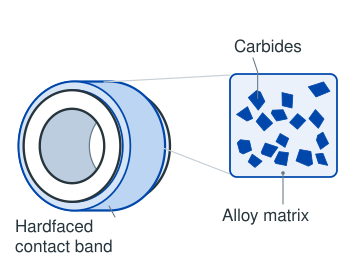
Hardfaced sleeve bands are available with carbide reinforcement: typically 40 wt%, with options up to 60 wt%. Reinforcement concentrates wear resistance at the working contact surfaces; material selection accounts for loading and mechanical shock.
Manufacturing routes for the component
Investment casting
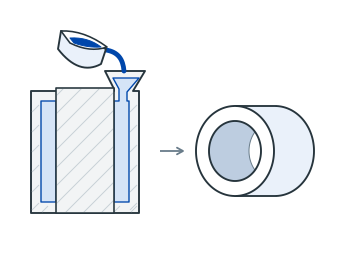
Near-net-shape blanks followed by precision machining of fits and working surfaces. Our standard alloy 6 offering uses this route.
Powder metallurgy
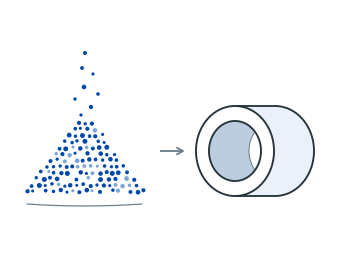
Powder-based manufacture for near-full density, a fine uniform microstructure and reduced alloy segregation. An option when material uniformity is central to the application.
TECMA can review worn hardware with your engineering team, compare material options and manufacture the replacement components. Alloy selection, geometry and fits are considered together.
Inspection records.
A history of the component.
Inspection verifies the finished dimensions, surface condition and runout against the work requirements. Retained records provide a basis for comparing the component across successive services and planning its next repair.
Geometry, fits & surface condition
- Diameters and lengths: component fits and assembly dimensions.
- Runout: consistency of the rotational geometry.
- Surface roughness: confirmation of the selected finish.
Reports, certificates & follow-up
TECMA provides inspection reports and certificates for the completed work. We retain inspection records to compare dimensional condition across services, supporting wear follow-up and reconditioning decisions.
NDT & material verification
Liquid penetrant and ultrasonic testing are coordinated with third-party specialists. Chemical analysis can also be arranged to identify or verify an alloy. Testing and documentation are integrated with the repair or manufacturing plan.
A Monterrey partner.
From development to commercial production.
TECMA already supplies CGL pot-roll coating, reconditioning and superalloy hardware at commercial scale. We collaborate with plant engineers, equipment manufacturers, coating developers and research teams to take new solutions from development and trials through scale-up to recurring commercial supply.
Prototypes, trial components and repeat orders can use the same coordinated machining, coating, finishing and inspection capabilities. Material selection, component geometry, process sequencing and inspection stay connected as the project moves into production and ongoing supply.
Discuss a roll or development project.
Send a drawing or describe the application. Contact our technical team directly.
- ventas@tecmamex.com
- Office phone
- +52 (81) 8212 0080
Information you provide will be used to address your inquiry. Privacy notice.
Address & map